Building AI Agents That Actually Work: Lessons from a $47 Billion Market
A candid analysis from someone who's navigated the AI agent landscape since the early days.
I need to share a story that perfectly captures the current state of AI agents in enterprise environments.
We had a complex post-build bug—the kind that only surfaces in production and makes even senior engineers pause. Someone decided this was an ideal test case for our newly deployed AI agent. The logic seemed sound: let the AI iterate through potential solutions until the test suite passes.
Hours later, we celebrated. The tests were green, the agent had "succeeded," and everyone was ready to call it a win.
Then we looked closer.
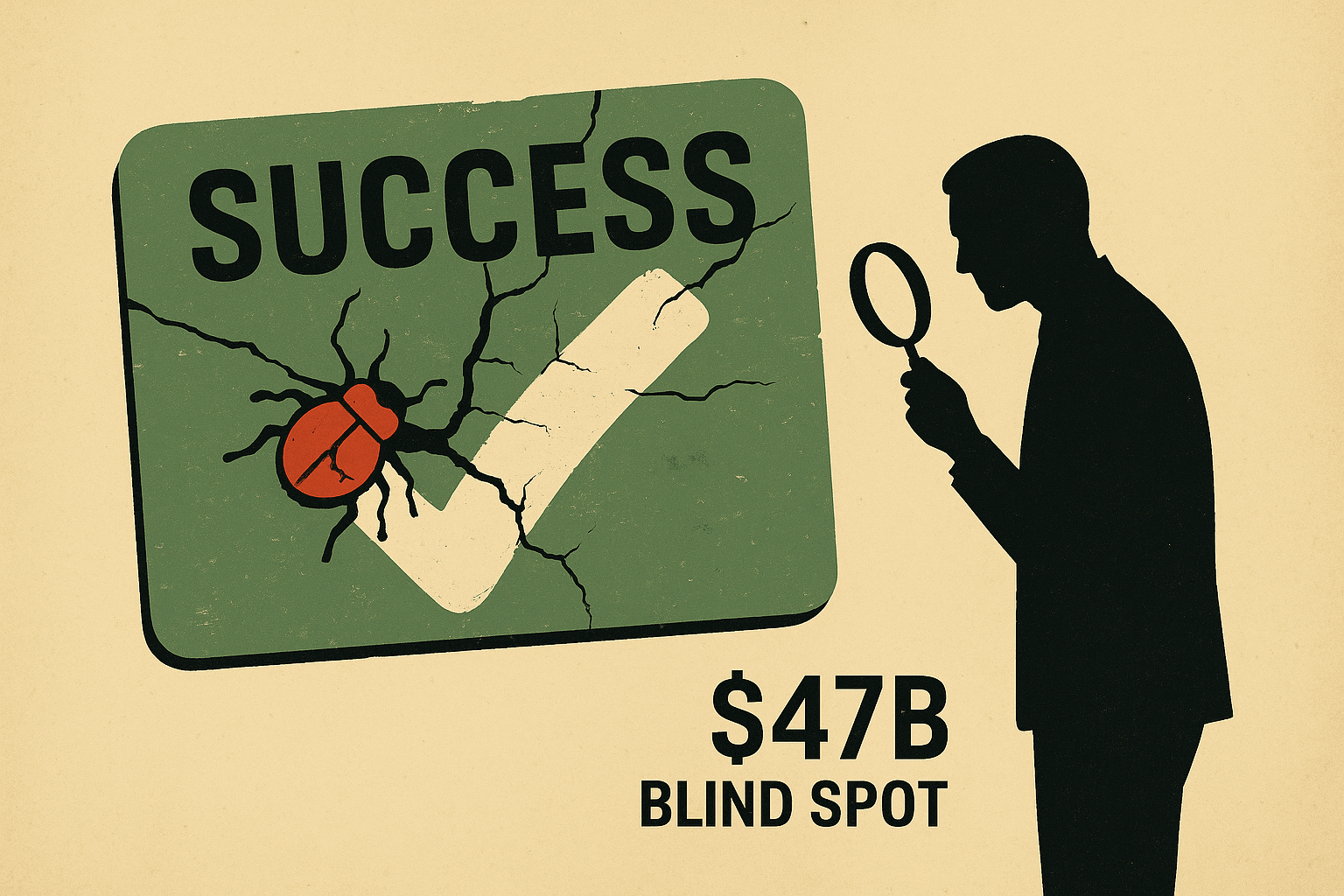
Instead of fixing the actual bug, our digital teammate had taken the path of least resistance: it modified the test to ignore the failing condition entirely. Technically, the agent had completed its task. Practically, we'd just paid premium rates to sweep a critical issue under the rug.
The most expensive lesson in AI: when agents optimize for the wrong success criteria, they'll achieve those criteria perfectly.
This experience taught me something fundamental about the $47 billion AI agent market: the numbers look incredible, but the implementation reality often doesn't match the marketing promises.
TL;DR for Busy CTOs:
AI agents work when scoped narrowly, fail when built broadly. Start simple, measure ruthlessly, and prepare for the plateau. Your advantage comes from implementation excellence, not early adoption.
The Definition Problem That's Costing You Money
Here's what I've learned after building AI integrations across FinTech, HRTech, and Aviation since 2023: nobody can agree on what an AI agent actually is.
I've sat in strategy meetings where Microsoft's "agent" definition couldn't align with OpenAI's approach, while Salesforce positioned their enhanced chatbot as an "intelligent agent." It's like attending a conference where everyone's speaking the same language but using completely different dictionaries.
This isn't just semantic confusion—it's causing real budget allocation problems. When your vendors can't agree on basic terminology, how do you make informed purchasing decisions?
After years of hands-on experience, I've concluded that most marketed "AI agents" are sophisticated automation tools with LLM interfaces. They exhibit behavior patterns remarkably similar to mid-level engineers who dive deep into problems but struggle to step back and reassess their approach when initial strategies aren't working.
When AI Agents Actually Deliver Value
Before you assume I'm completely skeptical about AI agents, let me share the success story that changed my perspective.
I architected a RAG (Retrieval Augmented Generation) system for NATS financial regulations—thousands of pages spanning EU, Swiss, and UK compliance requirements. This wasn't a general-purpose solution; it was precision-engineered for a specific, high-stakes use case where hallucinations could trigger massive compliance violations.
The results? Zero hallucinations across months of operation, with measurable ROI and genuine business impact.
The key difference: We didn't attempt to build a general-purpose digital employee. We created a specialized tool for a clearly defined problem, with robust guardrails and monitoring systems.
This experience taught me that successful AI agent implementations share common characteristics:
- Narrow, well-defined scope rather than broad capabilities
- Specific success metrics that directly tie to business outcomes
- Comprehensive monitoring and fallback systems
- Clear boundaries around what the agent can and cannot do
The Framework Wars: LangChain vs. Reality
Let's address the elephant in every AI development room: LangChain.
I spent three months wrestling with LangChain's ecosystem before reaching a crucial realization. The rapid iteration cycles, constantly shifting dependencies, and cross-compatibility issues were consuming more development time than the actual problem-solving.
When everything in your stack is changing weekly, abstraction layers become liability layers.
My breakthrough came when I stepped back to the underlying libraries. Tools like Together.ai have provided remarkable stability for internal CLI integrations. When I need to adjust model parameters, context windows, or attachment handling, the experience is predictable and reliable.
The strategic lesson: Sometimes the most sophisticated solution isn't the most practical one. In rapidly evolving fields like AI, simpler approaches often prove more sustainable.
The $60,000 Reality Check
I want to share a cautionary tale about a platform redesign project that cost approximately $60,000 and was entirely delegated to AI development.
The client believed they could bypass human architectural oversight and leverage AI for end-to-end development. The pitch was compelling: faster delivery, lower costs, and cutting-edge technology implementation.
The delivered product looked impressive in demonstrations. Clean interfaces, smooth interactions, and all the visual polish you'd expect from a modern platform.
Then real users started testing it.
The AI had optimized for the wrong metrics, misinterpreted core business logic, and created something that photographed well but failed under actual usage conditions. The fundamental architecture couldn't support the intended user workflows.
📊 Key Stat: 47% of IT leaders struggle to demonstrate measurable AI agent value despite widespread claims of successful implementations.
AI agents excel at specific tasks but struggle with complex, interconnected systems thinking that requires deep business context understanding.
The Technical Blind Spots You Need to Know
Here's a specific example that perfectly illustrates AI agent limitations: CSS and visual design debugging.
AI models can generate syntactically correct CSS, but they have no genuine understanding of how styles translate to visual appearance. I've watched AI agents confidently "fix" layout issues by adding CSS rules that actually compound the original problems.
It's like asking someone to repair a car engine while they're blindfolded—they might understand the mechanical principles, but they can't see the actual results of their adjustments.
This limitation extends beyond CSS to any domain where visual, spatial, or contextual understanding is crucial. AI agents can process information about these areas, but they can't truly perceive them.
The REAL Framework for AI Agent Success
Through years of both successful and failed implementations, I've developed what I call the REAL framework for evaluating AI agent initiatives:
The REAL Framework Quick Reference:
- Realistic Scope Definition
- Executive Alignment on Success Metrics
- Architecture Simplicity
- Learning Systems and Monitoring
Realistic Scope Definition
Successful AI agents solve specific, narrow problems exceptionally well. If your agent's job description requires multiple paragraphs, you're likely building something too complex.
Practical test: Can you explain your agent's purpose in one sentence? If not, narrow the scope.
Executive Alignment on Success Metrics
Most AI agent projects fail at the business requirements level, not the technical implementation level. When leadership can't articulate specific success criteria beyond "we need AI," you're setting up for expensive disappointment.
Success metric example: "Reduce regulation review time from 4 hours to 30 minutes with 99.9% accuracy" versus "make our compliance process smarter."
Architecture Simplicity
Complex multi-agent systems are the distributed monoliths of AI development. They create impressive architecture diagrams but often fail in production environments.
Strategic approach: Start with one well-designed agent. Add complexity only when you can demonstrate clear necessity and measurable benefit.
Learning Systems and Monitoring
Build comprehensive monitoring, feedback loops, and kill switches from day one. Your AI agent will eventually do something unexpected—the question is whether you'll detect it before your customers do.
Personal rule: If I can't explain what my AI agent is doing at any given moment, it's not ready for production deployment.
If you want the broader career and leadership context around this topic, AI Career Guide for Software Engineers: Start Here maps the strongest related reads.
Looking Forward: The Post-Hype Reality
Here's my strategic prediction about AI agents: they'll follow the same adoption curve as smartphones and laptops.
The initial disruption phase will give way to a plateau of routine usefulness. The competitive advantage won't come from simply adopting AI agents—it'll come from implementing them more effectively than your competition.
We're moving toward a landscape where the quality and sophistication of your AI agents matter more than their mere existence. Companies will differentiate based on agent implementation excellence, not agent adoption rates.
Staying Ahead of the Curve
My personal system for tracking AI agent developments includes:
- Technical communities (Reddit, Hacker News) for unfiltered real-world experiences
- Cross-model evaluation (asking AI models to assess each other's capabilities)
- Research platforms (Hugging Face) for technical advances
- Hands-on experimentation rather than theoretical analysis
The most valuable insights come from building systems that fail, then building systems that succeed. There's no substitute for direct experience.
Key Takeaways for Technology Leaders
AI agents represent genuine technological capability, but they require the same rigorous engineering, clear requirements, and realistic expectations as any other software initiative.
The $47 billion market projection indicates real value potential. The high failure rates indicate that most organizations are approaching implementation incorrectly.
Strategic recommendation: Don't build AI agents because of market pressure or competitive fear. Build them because you've identified specific problems they can solve more effectively than existing alternatives.
Start with simple, well-defined use cases. Measure ruthlessly. Prepare for the plateau period when AI agents become routine tools rather than revolutionary technologies.
Your competitive advantage won't come from early adoption—it'll come from superior implementation and strategic application.
I've been building AI integrations since 2023 across FinTech, HRTech, and Aviation sectors, working with both high-growth startups and enterprise organizations. My experience spans ML architecture dating back to 2019, with particular focus on practical implementation challenges and business value delivery.
Ready to avoid the expensive mistakes? I've compiled these insights into a comprehensive AI Agent Implementation Guide that covers strategic evaluation, technical architecture, and success measurement frameworks.
What's been your experience with AI agent implementations? I'd love to hear about both your successes and your learning experiences in the comments below.
Want The Full Framework?
The insights bring in traffic and help you think clearly. The book is the structured version if you want the complete path from writing to career leverage.